




Micron Rating Guide for Cartridge Filter Housing Procurement
- Micron Rating Guide for Cartridge Filter Housing Procurement
- What is a cartridge filter housing and why it matters in procurement
- Understanding micron ratings and their significance for cartridge filter housing
- Common micron ratings for cartridge filter housing and typical applications
- How to choose the right micron rating for your Multi-cartridge Filter Housing stainless steel micron filter for water purification
- Flow, area and micron rating trade-offs in cartridge filter housing procurement
- Multi-cartridge vs single-cartridge housings: procurement considerations
- Material selection: why stainless steel cartridge filter housings are often preferred
- Installation and maintenance best practices for cartridge filter housing
- Compliance, testing and validation when procuring cartridge filter housing
- Procurement checklist for cartridge filter housing
- Brand advantages: why choose our Multi-cartridge Filter Housing stainless steel micron filter for water purification
- Typical procurement scenarios and recommended micron ratings
- Frequently Asked Questions (FAQ) about micron rating and cartridge filter housing
- Q: What is the difference between nominal and absolute micron ratings?
- Q: Can I use a finer micron rating to ensure better water quality?
- Q: How does a multi-cartridge housing affect filtration performance?
- Q: Are stainless steel housings always necessary?
- Q: What documentation should I request from suppliers when procuring cartridge filter housing?
- Contact us / View product
- Authoritative references
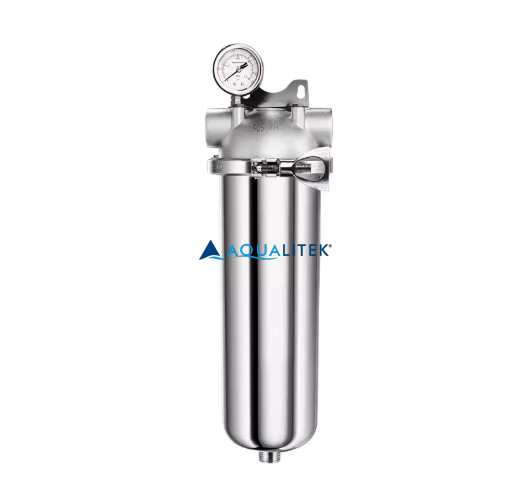
Micron Rating Guide for Cartridge Filter Housing Procurement
What is a cartridge filter housing and why it matters in procurement
Cartridge filter housing is a critical component in liquid filtration systems, designed to securely hold and protect filter cartridges while allowing liquids to flow through the filter media. These housings are essential for industries that require reliable filtration solutions to remove contaminants from liquids, such as water treatment, pharmaceuticals, food and beverage processing, chemicals, and industrial applications.
Cartridge filter housings are typically constructed from durable materials like stainless steel, polypropylene, or fiber glass, providing excellent resistance to corrosion and ensuring long-term performance. They are available in a variety of configurations, including single or multi-cartridge designs, to accommodate different flow rates and filtration needs. These housings are engineered to securely seal the filter cartridges, preventing any bypass of unfiltered liquid, ensuring the integrity of the filtration process.
Designed for easy maintenance, cartridge filter housings offer the flexibility to replace or clean filter cartridges quickly, making them a convenient solution for systems requiring regular maintenance. Their efficiency and versatility make them ideal for applications where precise filtration is crucial for improving the quality of liquids, whether for industrial processes, potable water production, or high-purity applications.
Understanding micron ratings and their significance for cartridge filter housing
The term micron rating refers to the nominal or absolute pore size of a filter's media, expressed in micrometers (µm). When procuring a cartridge filter housing, selecting the correct micron rating for the cartridges installed inside the housing is essential because it directly determines the size of particles removed, the flow performance, and the lifecycle costs of the filtration system.
Key procurement implications of micron ratings for cartridge filter housing include:
- Filtration target: The micron rating must match the contaminants to be removed (sediment, bacteria, colloids, etc.).
- Flow rate & capacity: Smaller micron ratings generally increase differential pressure and reduce flow unless compensated by larger cartridge area or multi-cartridge housings.
- Lifecycle cost: Finer filtration can mean more frequent cartridge changes and higher energy or pumping costs.
- Regulatory compliance: Some industries require specific micron performance for safety and quality standards.
Common micron ratings for cartridge filter housing and typical applications
Below is a practical comparison table to help procurement teams choose the right micron rating for a given application when specifying a cartridge filter housing like the Multi-cartridge Filter Housing stainless steel micron filter for water purification.
| Micron Rating (µm) | Approx. Particle Size | Target Contaminants | Typical Applications |
|---|---|---|---|
| >100 µm | Large particulates | Leaves, coarse sediment | Pre-filtration for raw water, industrial intake |
| 50–100 µm | Coarse sand, grit | Sand, coarse solids | Process protection upstream of pumps and heat exchangers |
| 10–50 µm | Fine sand, silt | Rust, silt, algae | General water treatment, food industry pre-filter |
| 1–10 µm | Bacterial aggregates, fine colloids | Some bacteria, fine particles, colloids | Drinking water polishing, beverage filtration |
| 0.2–1 µm | Bacteria & fine colloids | Bacteria (retention depends on absolute rating), fine colloids | Pharmaceuticals, high-purity water systems |
| <0.2 µm | Viruses, submicron particles | Viruses (requires validated membrane), endotoxins (with specific media) | Sterile filtration, critical pharmaceutical applications |
How to choose the right micron rating for your Multi-cartridge Filter Housing stainless steel micron filter for water purification
Selecting the correct micron rating entails several steps and trade-offs. For procurement teams specifying a cartridge filter housing, follow this structured approach:
- Define the contaminants and quality targets: Test feed water for turbidity, particle size distribution, microbial content, and chemical contaminants. Determine the required output quality (e.g., turbidity < 1 NTU, particle removal to X µm, regulatory limits).
- Set flow rate and system capacity: Calculate peak and average flow rates. Multi-cartridge housings increase available filter area, enabling finer micron ratings at acceptable flow rates and lower pressure drops.
- Balance pressure drop and cartridge life: Finer media increase initial and accumulated differential pressure. Opt for larger surface area cartridges or multi-cartridge housings to reduce pressure drop and extend service intervals.
- Material compatibility: Ensure the housing and cartridge materials are compatible with water chemistry (pH, oxidants like chlorine, solvents). Stainless steel housings like the Multi-cartridge Filter Housing stainless steel micron filter are preferred for corrosive or high-temperature streams.
- Validate and test: Where regulatory compliance or product safety is critical, require vendor-supplied test data (beta ratio, retention efficiency) and consider third-party validation.
Flow, area and micron rating trade-offs in cartridge filter housing procurement
For the same micron rating, increasing filter area (for instance by selecting a multi-cartridge housing) reduces face velocity and pressure drop, thereby improving cartridge life and reliability. Procurement should compare options by required replacement frequency, total cost of ownership (TCO), and downtime impact.
Multi-cartridge vs single-cartridge housings: procurement considerations
When evaluating a cartridge filter housing, the choice between single and multi-cartridge formats affects footprint, redundancy, maintenance time, and cost. Below is a quick comparison table to guide decisions.
| Aspect | Single-cartridge Housing | Multi-cartridge Housing |
|---|---|---|
| Footprint | Smaller | Wider/longer |
| Flow capacity | Lower | Higher (parallel cartridges) |
| Redundancy | Limited | Better—one cartridge can be serviced while others operate |
| Maintenance | Faster cartridge changes | May require more effort per change, but less frequent overall |
| Cost | Lower initial cost | Higher initial cost — lower cost per treated volume in many cases |
Material selection: why stainless steel cartridge filter housings are often preferred
For many industrial and high-purity water applications, stainless steel multi-cartridge housings (such as the Multi-cartridge Filter Housing stainless steel micron filter for water purification) are preferred due to:
- Corrosion resistance in varied pH and oxidizing environments.
- Durability under higher temperatures and pressures.
- Cleanability and compatibility with CIP (clean-in-place) and steam sterilization.
- Longevity and lower long-term capital replacement frequency.
Procurement should ensure housings meet pressure, temperature and material traceability specifications required by the application (e.g., 316L stainless steel for sanitary applications).
Installation and maintenance best practices for cartridge filter housing
Successful operation of a cartridge filter housing depends on careful installation and regular maintenance:
- Install differential pressure gauges upstream and downstream to monitor cartridge loading.
- Follow manufacturer torque and seal instructions to avoid bypass or seal damage.
- Replace cartridges at predetermined differential pressure or time intervals; do not rely solely on visual inspection.
- Keep spare cartridges and sealing gaskets on site to reduce downtime.
Compliance, testing and validation when procuring cartridge filter housing
Many industries require documented evidence of filtration performance. When procuring a cartridge filter housing, request the following documentation from suppliers:
- Material certificates (e.g., EN/ASTM for stainless steel).
- Performance data: nominal vs absolute micron ratings, efficiency curves, beta ratios (for depth and membrane filters).
- Third-party certifications where applicable (NSF/ANSI for potable water, USP or FDA compliance for pharmaceutical/food use).
- Pressure and temperature ratings, and test reports for housing integrity.
Procurement checklist for cartridge filter housing
Use this checklist to ensure you select the correct cartridge filter housing and micron rating:
- Define required effluent quality and maximum allowable particle size.
- Verify flow rate and peak demands; choose housing and cartridge count accordingly.
- Confirm material compatibility (housing and seals) with process fluids.
- Obtain test data and certifications for filter cartridges and housings.
- Estimate TCO: cartridge cost, replacement frequency, energy/pump costs due to pressure drop, downtime.
- Check serviceability: headroom for cartridge changes, availability of spare parts and local support.
- Include installation, commissioning, and validation steps in the procurement contract.
Brand advantages: why choose our Multi-cartridge Filter Housing stainless steel micron filter for water purification
When comparing brands and models of cartridge filter housing, our Multi-cartridge Filter Housing stainless steel micron filter for water purification offers these key advantages:
- High-quality stainless steel construction: Durable 316/316L options resist corrosion and enable CIP/sterilization cycles.
- Modular multi-cartridge design: Flexible cartridge counts to match flow and micron requirements while minimizing pressure drop.
- Industry-standard seals and fittings: Easy integration with existing piping and instrumentation.
- Comprehensive documentation: Material certificates, pressure ratings and performance data to support regulatory compliance.
- Local support and spare parts: Reduced downtime thanks to available cartridges, gaskets and technical assistance.
- TCO-focused engineering: Designed to balance micron performance with long service life and minimized operating cost.
Typical procurement scenarios and recommended micron ratings
Examples to guide decision-making for common use cases:
- Municipal pre-treatment before RO membranes: 5–10 µm cartridges in a multi-cartridge stainless housing to protect downstream membranes.
- Beverage or food processing final polishing: 1–5 µm in sanitary housings with food-grade seals.
- Industrial process water for heat exchangers: 10–50 µm to prevent fouling and erosion.
- Pharmaceutical high-purity water: 0.2–1 µm validated membrane cartridges in 316L housings with traceable certifications.
Frequently Asked Questions (FAQ) about micron rating and cartridge filter housing
Q: What is the difference between nominal and absolute micron ratings?
A: Nominal ratings indicate the approximate percentage of particles of that size retained (e.g., 90% at X µm) while absolute ratings indicate a defined retention level (commonly 99.9% or higher) at the stated micron size. For critical applications, specify absolute-rated cartridges and require test data.
Q: Can I use a finer micron rating to ensure better water quality?
A: Finer filtration improves particle removal but increases pressure drop and replacement frequency. Consider multi-cartridge housings or larger area cartridges to achieve fine filtration with reasonable operating costs.
Q: How does a multi-cartridge housing affect filtration performance?
A: Multi-cartridge housings increase cumulative filter area, lowering face velocity and differential pressure at a given flow rate. This allows finer micron cartridges to be used without prohibitive pressure drop, extending cartridge life.
Q: Are stainless steel housings always necessary?
A: Not always. For non-corrosive, low-temperature, and non-critical applications, polypropylene housings may be sufficient and cost-effective. Use stainless steel for corrosive media, higher temperatures, or where sterilization is required.
Q: What documentation should I request from suppliers when procuring cartridge filter housing?
A: Request material certificates, pressure/temperature ratings, performance curves (beta ratios), certifications (NSF/ANSI, FDA, USP as applicable), and test reports for both the housing and cartridges.
Contact us / View product
If you are ready to specify a Multi-cartridge Filter Housing stainless steel micron filter for water purification or need help choosing the right micron rating for your cartridge filter housing, contact our sales and technical team for a tailored quote and application review. Click to view product details or request a consultation and datasheet.
Authoritative references
- Filter (technology) — Wikipedia
- U.S. EPA — Drinking Water and Ground Water
- NSF International — Standards and Certification
- International Organization for Standardization (ISO)
- WHO — Water, Sanitation and Health
For procurement assistance, product specifications, or to schedule a site assessment, contact our sales team today.
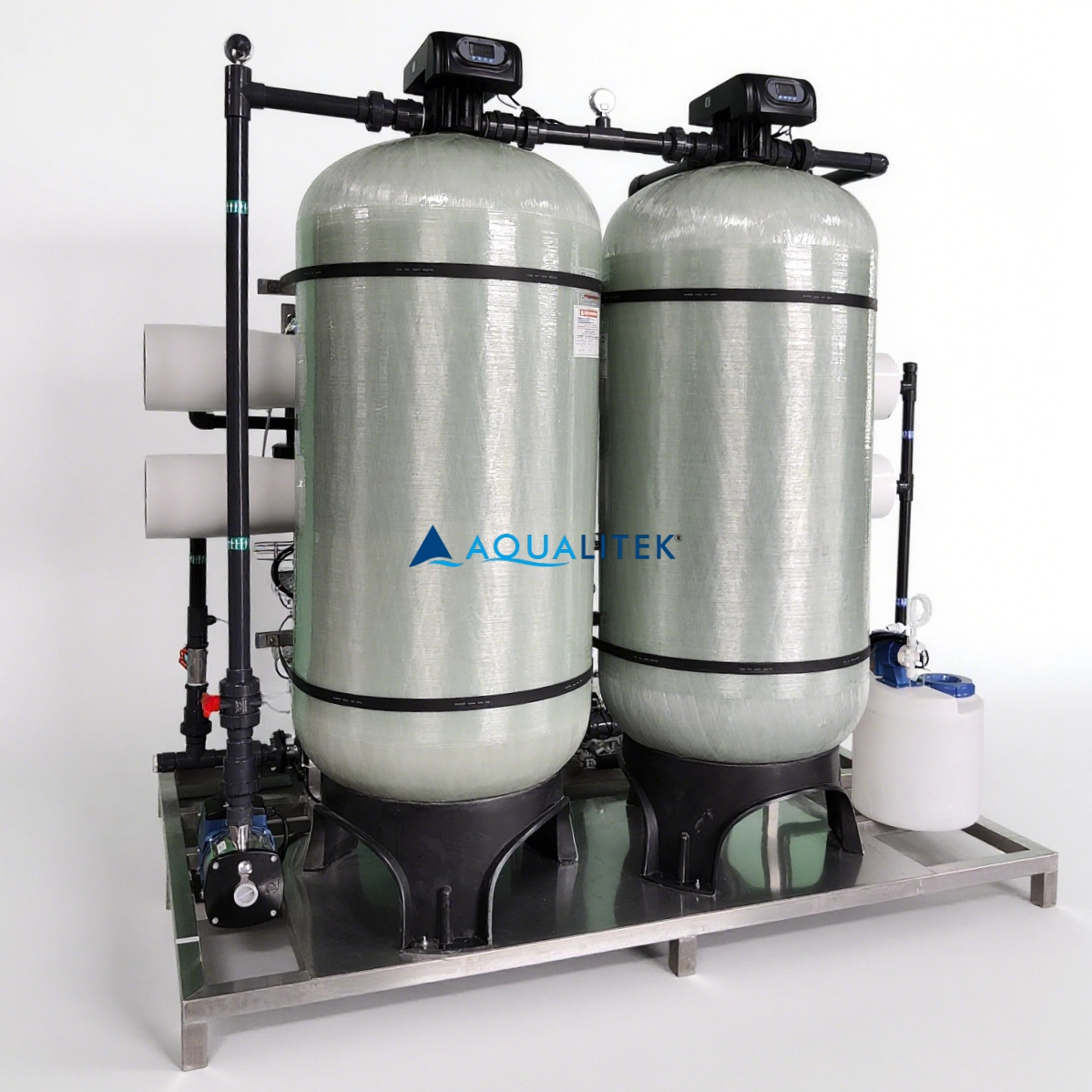
Energy Efficiency Metrics for Industrial RO System Procurement
Top Innovations from Reverse Osmosis System Manufacturers 2025
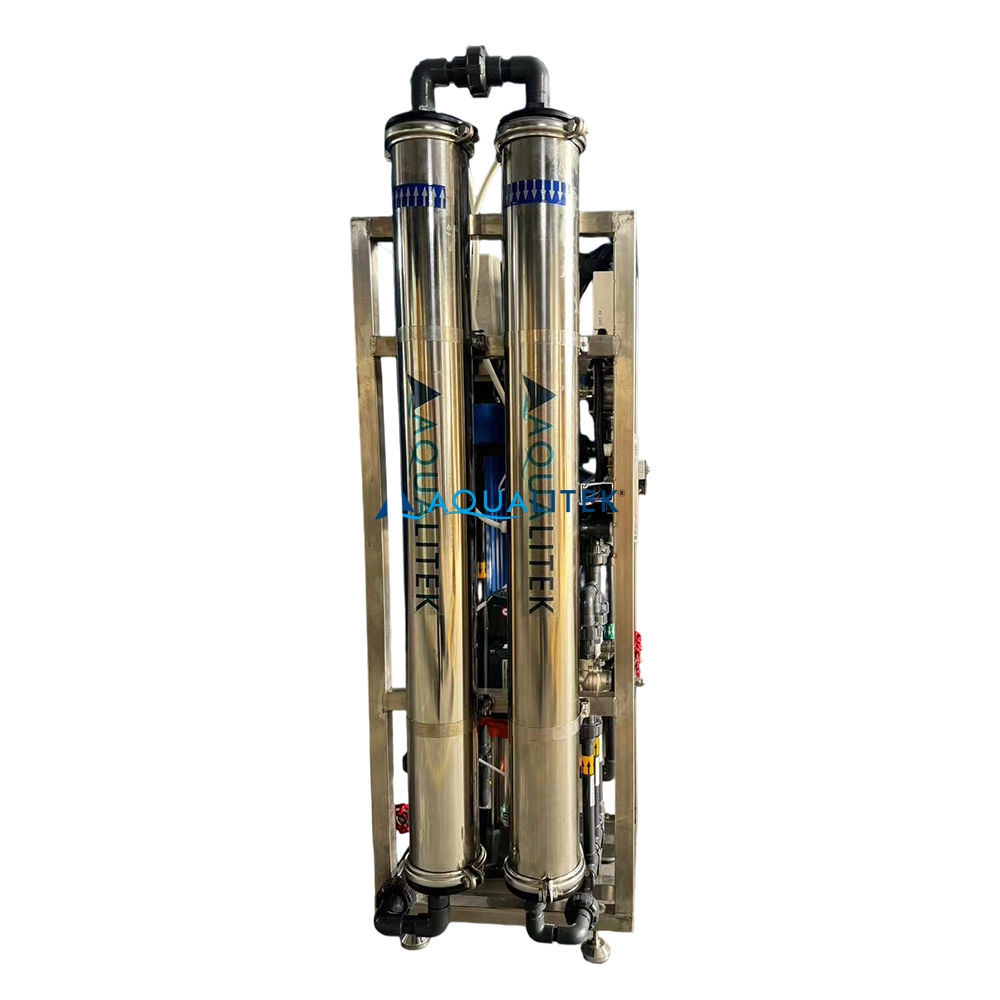
TWV - 412 500 LPH RO Machine vs Home RO: Capacity & Maintenance
Choosing Filtration Systems for Sediment and Turbidity
Blog
Is softened water safe to drink?
Yes, but those on low-sodium diets should consider potassium-based softeners or install a separate drinking water filter.
Can I use a water softener with a septic system?
Yes. Studies show no negative impact, especially when using metered regeneration systems.
Ion Exchange Water Treatment Systems
Which chemicals are required for regeneration?
Softening uses NaCl. Demineralization uses HCl or H₂SO₄ for cation resin and NaOH for anion resin.
Solutions
Can I use AQT’s water treatment systems for seawater desalination?
Yes! We provide seawater desalination systems using advanced reverse osmosis (RO) technology, specifically designed to convert seawater into fresh, drinkable water. These systems are ideal for coastal communities, marine applications, and industrial desalination projects.
FAQ-aqualitek
What types of water treatment systems does AQT offer?
AQT provides a wide range of water purification solutions, including reverse osmosis (RO) systems, ultrafiltration (UF) systems, nanofiltration (NF) systems, deionization (DI) systems, electro-deionization (EDI) systems, chemical dosing systems, and water softeners. We also supply spare parts and components for water treatment systems.
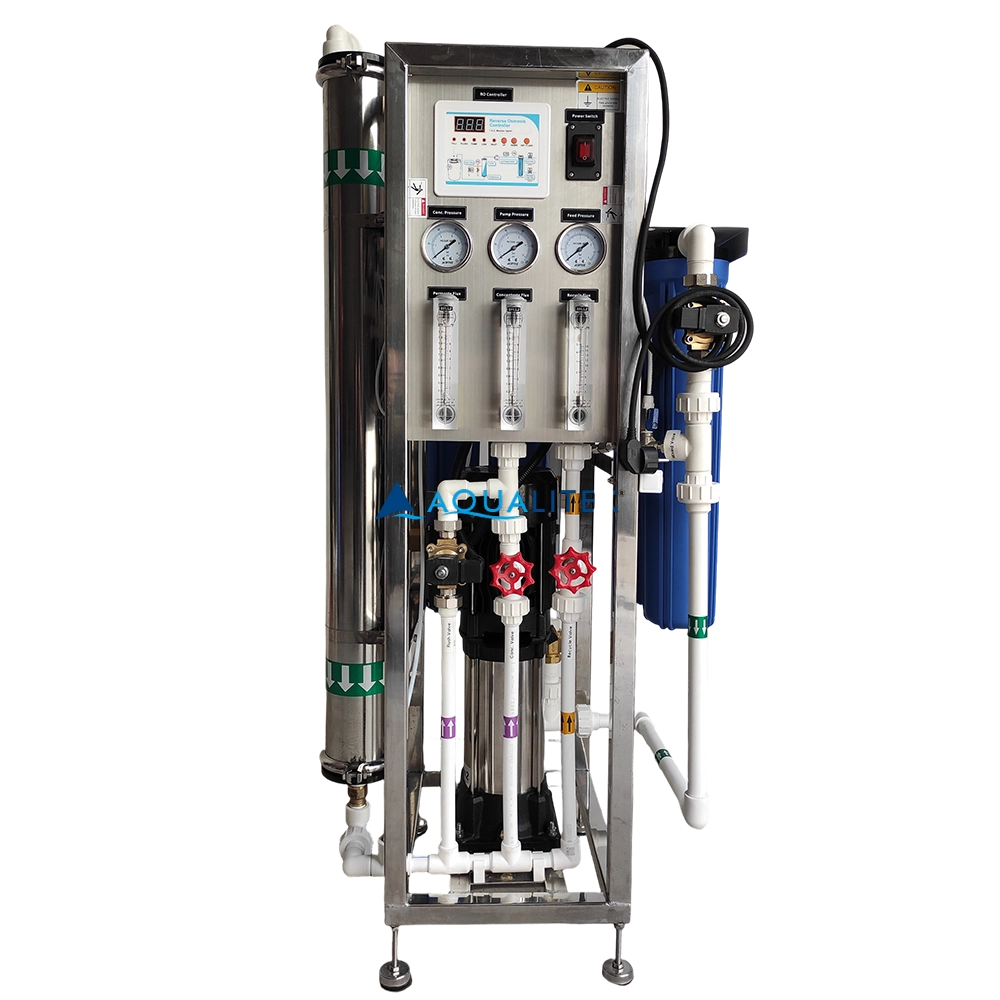
500 LPH Reverse Osmosis (RO) Water Purification Machine TWV - 412
Our 500 LPH Reverse Osmosis (RO) System is engineered to provide high-quality purified water for commercial applications. Designed with advanced RO technology, durable components, and a user-friendly interface, this system ensures consistent performance, low maintenance, and long-term reliability.
With its compact design and robust skid-mounted frame, it’s an excellent choice for businesses that demand efficiency and quality in water purification.
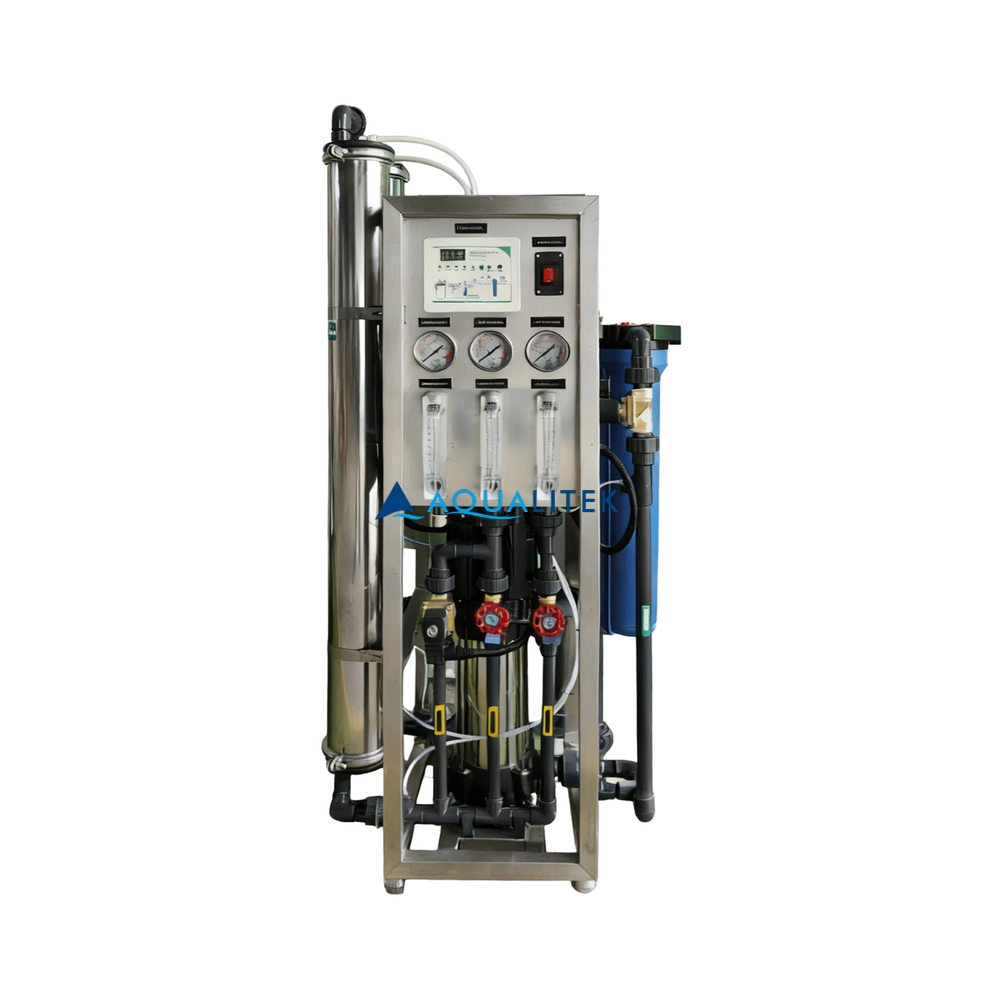
Tap Water Reverse Osmosis (TWRO) Systems TWV Series
TWV series Reverse Osmosis (RO) systems are pre-engineered and pre-assembled units with 2.5”/4” membrane housings(single element type)for tap water(lower TDS).They are designed for overall superior performance, high recovery rates and offer great savings with low maintenance and operation costs.
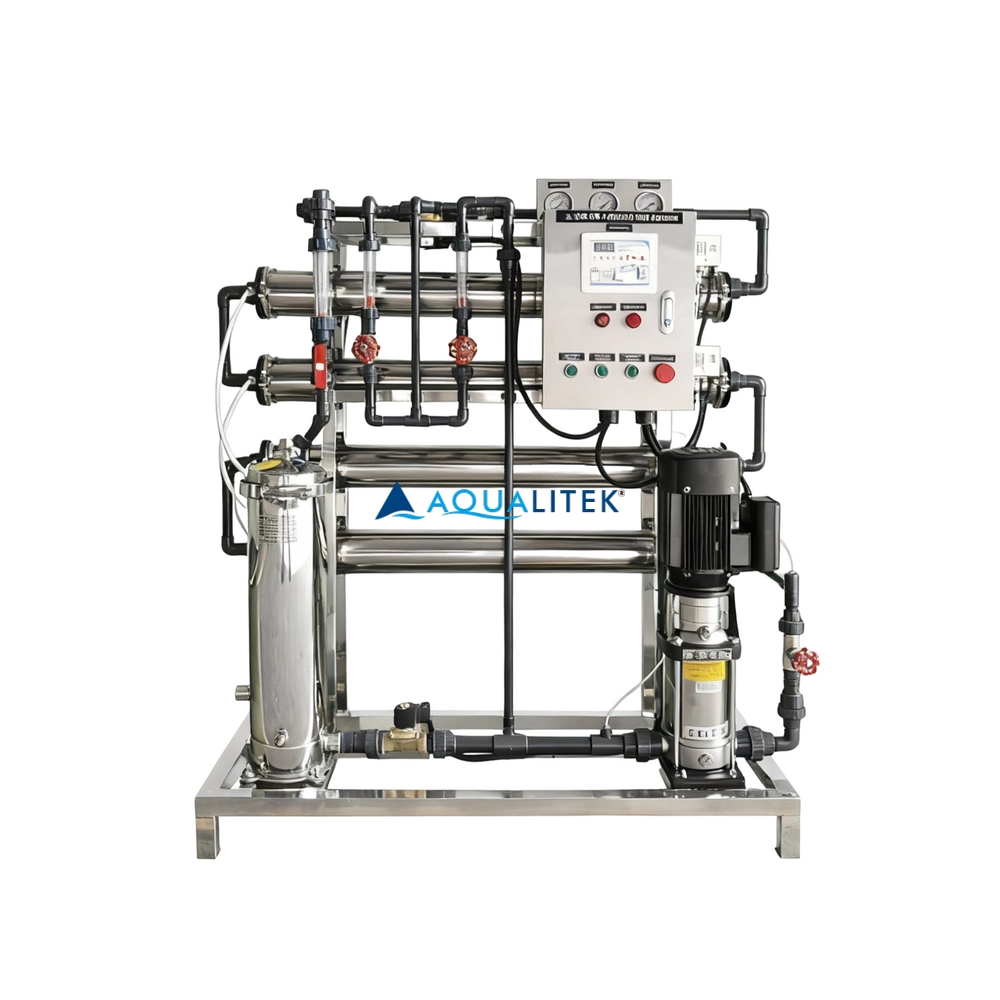
Tap Water Reverse Osmosis (TWRO) Systems TWF Series
TWF series Reverse Osmosis (RO) systems are pre-engineered and pre-assembled units with 4” membrane housings(multiple elements type) for tap water(lower TDS) .The medium large volumes can help meet your a variety of commercial and industrial applications. They are designed for overall superior performance, high recovery rates and offer great savings with low maintenance and operation costs.

Tap Water Reverse Osmosis (TWRO) Systems TWE Series
TWE series Reverse Osmosis (RO) systems are pre-engineered and pre-assembled units with 8” membrane housings for tap water (lower TDS). The large volumes can help meet your a variety of industrial applications. They are designed for overall superior performance, high recovery rates and offer great savings with low maintenance and operation costs.
Request More Information
Contact us today for product catalogs, customization options, and a free quotation designed for your business needs.
Rest assured that your privacy is important to us, and all information provided will be handled with the utmost confidentiality.
© 2026 AQUALITEK. All rights reserved.
AQUALITEK- Aimee Hoo
AQUALITEK - Aimee Hoo