




How Does an Energy Recovery Device Save Energy in a Seawater Desalination Plant?| Insights by AQUALITEK
Understand how energy recovery devices (ERDs) work in seawater desalination plants, how they recycle high-pressure brine energy, and why they are essential for low-energy SWRO systems.
- Introduction
- 1. Where Does the “Recoverable Energy” Come From?
- 1.1 High-Pressure Brine: The Hidden Energy Source
- 2. What Is an Energy Recovery Device (ERD)?
- 3. How ERDs Save Energy: Step-by-Step Explanation
- 3.1 Conventional System (Without ERD)
- 3.2 System with an Energy Recovery Device
- 4. Main Types of Energy Recovery Devices
- 4.1 Isobaric Pressure Exchangers (Most Advanced & Mainstream)
- 4.2 Turbines and Turbochargers (Older Technology)
- 5. How Much Energy Can ERDs Actually Save?
- 5.1 Typical Energy Comparison
- 6. Why Household RO Systems Do Not Use ERDs
- 7. Additional Benefits Beyond Energy Savings
- Conclusion
Introduction
Seawater reverse osmosis (SWRO) desalination is an energy-intensive process due to its extremely high operating pressure.
However, modern desalination plants are able to operate at surprisingly low energy consumption levels—often below 3 kWh/m³.
The key reason behind this efficiency is the Energy Recovery Device (ERD).
This article explains:
•What an ERD is
•Where the recoverable energy comes from
•How ERDs reuse that energy
•Why ERDs are indispensable in seawater desalination systems
1. Where Does the “Recoverable Energy” Come From?
1.1 High-Pressure Brine: The Hidden Energy Source
In an SWRO system:
•Seawater is pressurized to 55–70 bar
•Only 35–45% becomes product water
•The remaining 55–65% exits the membrane as high-pressure concentrate (brine)
This brine still contains:
•Nearly the same pressure as the feed
•Large amounts of hydraulic energy
Without an ERD, this energy would be wasted through throttling valves.
2. What Is an Energy Recovery Device (ERD)?
An energy recovery device is a hydraulic device that:
•Captures pressure energy from high-pressure brine
•Transfers it back to the incoming seawater
•Reduces the load on the high-pressure pump
ERDs do not create energy—they reuse energy that already exists in the system.
3. How ERDs Save Energy: Step-by-Step Explanation
3.1 Conventional System (Without ERD)
1.High-pressure pump supplies 100% of pressurization energy
2.Brine pressure is dissipated to near zero
3.Energy is completely lost
➡️ Result: Very high power consumption
3.2 System with an Energy Recovery Device
1.Brine exits the RO membrane at high pressure
2.ERD transfers this pressure directly to incoming seawater
3.High-pressure pump only needs to supply the remaining pressure difference
➡️ Result: 40–60% reduction in pump energy demand
4. Main Types of Energy Recovery Devices
4.1 Isobaric Pressure Exchangers (Most Advanced & Mainstream)
How they work:
•Direct pressure-to-pressure transfer
•No conversion to mechanical or electrical energy
•Extremely low losses
Performance:
•Energy recovery efficiency: 95–98%
•Pressure loss: typically < 1 bar
This is the dominant technology in modern SWRO plants.
4.2 Turbines and Turbochargers (Older Technology)
How they work:
•Brine drives a turbine
•Turbine assists the high-pressure pump
Limitations:
•Mechanical losses
•Lower efficiency (70–85%)
•Less suitable for variable flow
5. How Much Energy Can ERDs Actually Save?
5.1 Typical Energy Comparison
|
System Configuration |
Specific Energy Consumption |
|
SWRO without ERD |
6–8 kWh/m³ |
|
SWRO with turbine ERD |
3.8–4.5 kWh/m³ |
|
SWRO with isobaric ERD |
2.6–3.2 kWh/m³ |
➡️ Up to 60% energy savings compared with systems without ERDs.
6. Why Household RO Systems Do Not Use ERDs
Household RO systems:
•Operate at 3–7 bar
•Have minimal pressure energy in concentrate
•Do not generate enough recoverable energy
In contrast, seawater desalination:
•Operates at very high pressure
•Produces large volumes of high-pressure brine
•Makes ERDs economically essential
7. Additional Benefits Beyond Energy Savings
ERDs also:
•Reduce high-pressure pump size
•Lower mechanical stress
•Improve system stability
•Extend equipment lifespan
•Reduce operating costs (OPEX)
•Lower carbon footprint
Conclusion
Energy recovery devices save energy in seawater desalination plants by recycling the pressure energy stored in high-pressure brine instead of wasting it.
In summary:
•High-pressure brine contains valuable energy
•ERDs transfer that energy back to incoming seawater
•Modern ERDs recover up to 98% of this energy
•ERDs reduce SWRO energy consumption by 40–60%
•Without ERDs, large-scale seawater desalination would not be economically viable




Request More Information or Expert Advice
Share a few details, and we’ll provide deeper insights, tailored suggestions, or product support.
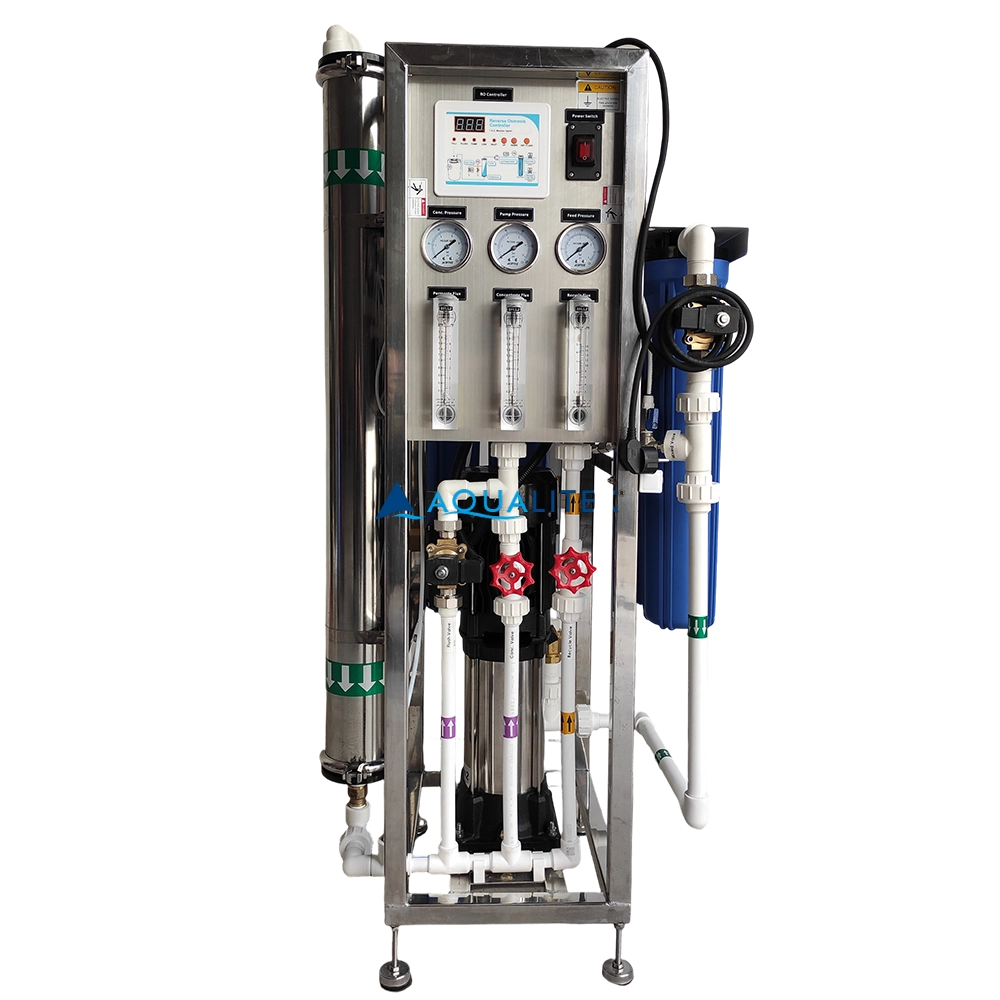
Our 500 LPH Reverse Osmosis (RO) System is engineered to provide high-quality purified water for commercial applications. Designed with advanced RO technology, durable components, and a user-friendly interface, this system ensures consistent performance, low maintenance, and long-term reliability.
With its compact design and robust skid-mounted frame, it’s an excellent choice for businesses that demand efficiency and quality in water purification.
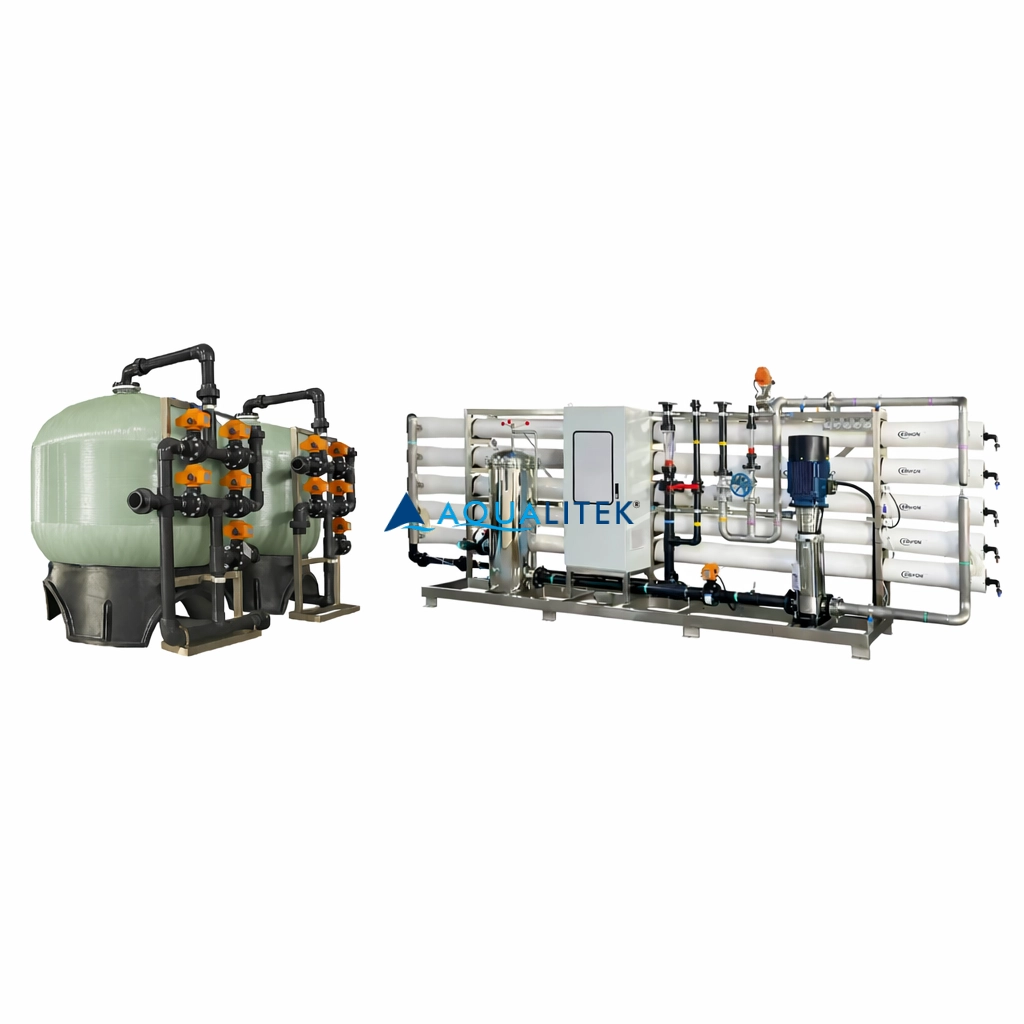
30TPH Industrial Reverse Osmosis (RO) System designed for industrial and municipal water treatment. High salt rejection, energy-efficient design, PLC control, and customizable configuration.
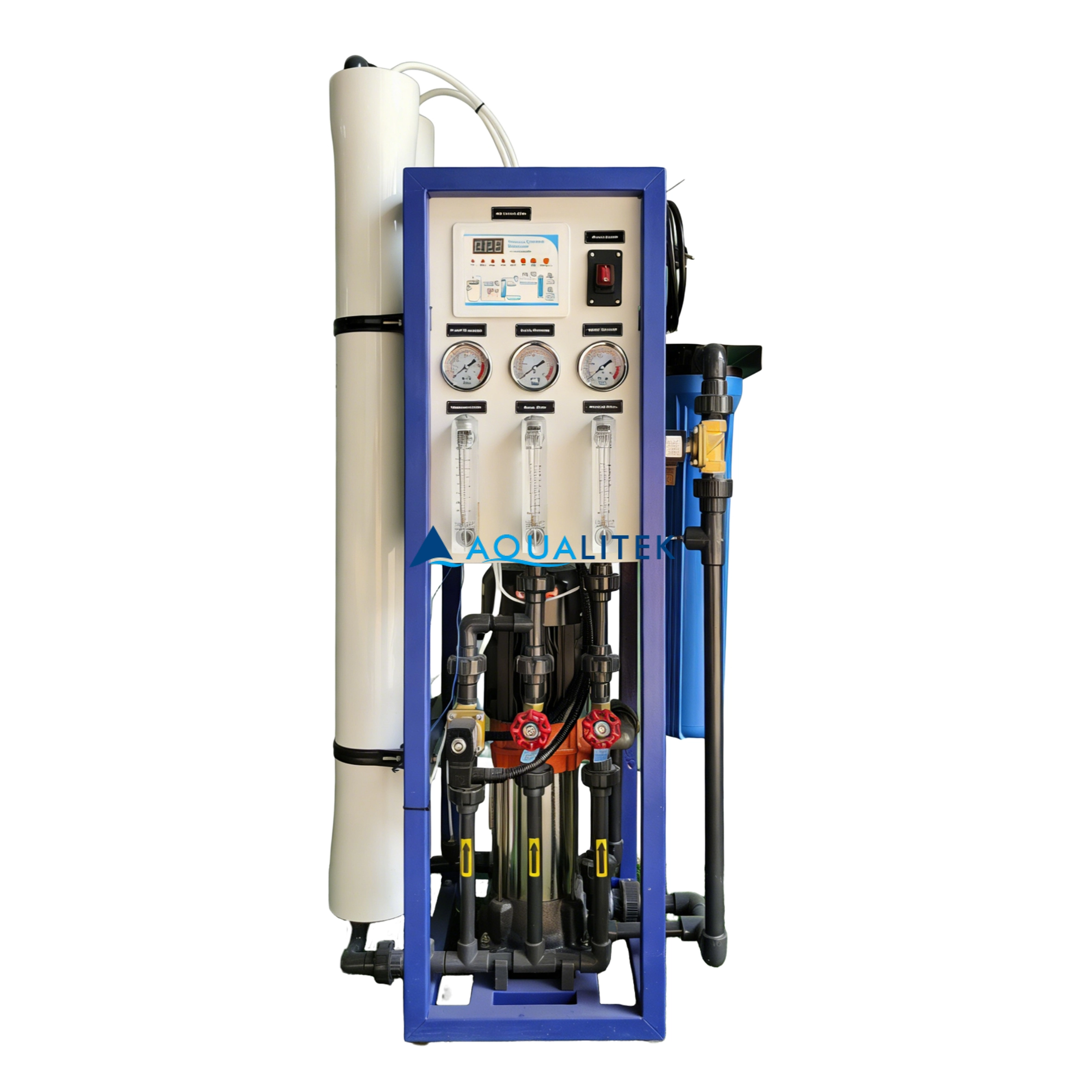
AQUALITEK's 500LPH Panel Mounted Reverse Osmosis Water Purification System delivers reliable 500 LPH RO water production. This compact industrial reverse osmosis unit is ideal for small scale industrial RO needs, ensuring efficient and high-quality purified water in a space-saving design.
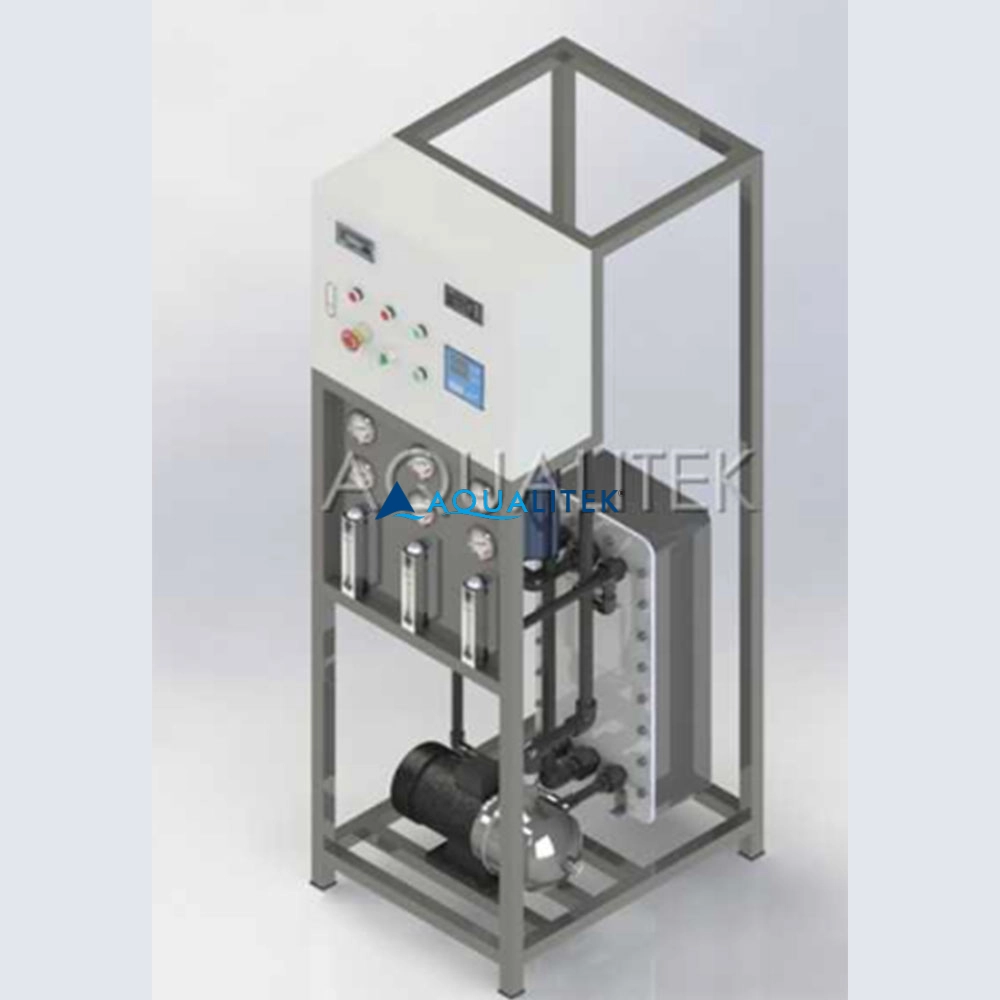
Electrodeionization (EDI) system is an advanced water purification technology that combines ion exchange and electrochemical processes to produce ultra-pure water. Unlike traditional deionization methods, which rely on chemical regeneration, EDI utilizes electric fields to drive the movement of ions through ion-exchange membranes, effectively removing dissolved salts and other ionic contaminants.
This process is continuous and does not require the use of chemicals for regeneration, making it an environmentally friendly and cost-effective solution for producing high-quality deionized water. EDI systems are widely used in applications requiring ultrapure water, such as in the pharmaceutical, semiconductor, power generation, and biotechnology industries, as well as for laboratory use.
By offering high-purity water without the need for chemical regeneration, EDI systems provide a sustainable, efficient, and reliable alternative to traditional deionization methods, making them an ideal choice for industries where water quality and process control are critical.
© 2026 AQUALITEK. All rights reserved.
AQUALITEK- Aimee Hoo
AQUALITEK - Aimee Hoo