




Installation Footprint and Space-saving Multi-cartridge Designs
- Why Installation Footprint Matters for Cartridge Filter Housing
- Understanding Multi-cartridge Filter Housing: Concept and Benefits
- Embedded commercial keyword: cartridge filter housing
- Design Features of Multi-cartridge Filter Housing stainless steel micron filter for water purification
- Space-saving Layout Strategies for Cartridge Filter Housing
- Embedded commercial keyword: Multi-cartridge Filter Housing stainless steel micron filter for water purification
- Engineering Considerations: Flow, Pressure Drop, and Cartridge Selection
- Maintenance and Operational Footprint: Accessibility and Downtime
- Material Choices: Why Stainless Steel Matters for Space-saving Designs
- Regulatory and Safety Constraints Affecting Footprint
- Comparing Single-cartridge versus Multi-cartridge Footprint and Performance
- Case Example: Packaging a High-flow Microfiltration Train in a Tight Plant Area
- Brand Advantages: Why Choose Our Multi-cartridge Filter Housing stainless steel micron filter for water purification
- Frequently Asked Questions (FAQ)
- Q1: How much floor space will a multi-cartridge cartridge filter housing save compared with single-cartridge housings?
- Q2: Can stainless steel micron filters be used with potable water systems?
- Q3: Is maintenance more difficult on a multi-cartridge housing?
- Q4: How do I choose between top-entry and side-entry multi-cartridge housings?
- Q5: What micron ratings are available for stainless steel cartridge filters?
- Contact and Product CTA
- Authoritative References and Further Reading
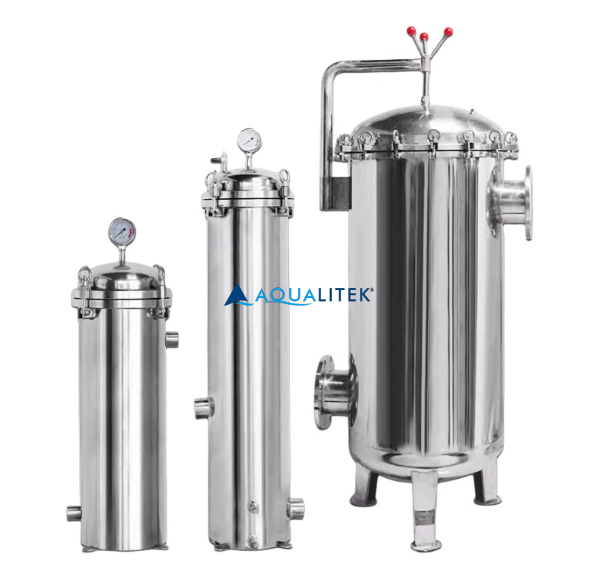
Why Installation Footprint Matters for Cartridge Filter Housing
Cartridge filter housing is a key element in any liquid filtration system, and its installation footprint is often a decisive factor for plant layout, capex, and operational efficiency. For industries such as water treatment, food and beverage, pharmaceuticals, and chemical processing, available floor space is limited and expensive. Multi-cartridge Filter Housing stainless steel micron filter for water purification offers a way to increase filtration capacity without proportionally increasing the physical footprint. This article explains how careful selection and design of cartridge filter housing can save space, reduce lifecycle costs, and meet strict performance and regulatory demands.
Understanding Multi-cartridge Filter Housing: Concept and Benefits
Multi-cartridge filter housing groups multiple filter cartridges inside a single pressure vessel. This design multiplies filtration area while sharing common inlet/outlet plumbing, closure, and support systems. For water purification, stainless steel micron filters in multi-cartridge housings provide robust, corrosion-resistant operation with consistent micron-level performance. Key benefits include higher flow capacity per footprint, simplified piping, and easier scale-up compared with many parallel single-cartridge systems.
Embedded commercial keyword: cartridge filter housing
Choosing the right cartridge filter housing means balancing flow, micron rating, maintenance access, and footprint. Multi-cartridge housings are especially advantageous when high flow rates are required in constrained spaces: they concentrate filtration elements vertically or compactly horizontally, rather than spreading them out across a plant floor.
Design Features of Multi-cartridge Filter Housing stainless steel micron filter for water purification
When evaluating Multi-cartridge Filter Housing stainless steel micron filter for water purification, look for these design features that directly influence footprint and performance:
- Stainless steel shell (typically 304 or 316L) for corrosion resistance and long life in potable and process water applications.
- Compact cartridge arrangement: nested or radial cartridge holders maximize usable filter area in a smaller volume.
- Top or side-entry closures that minimize clearance needs; top-entry designs often require more vertical space but less access around the vessel.
- Integrated manifolds or common headers that reduce external piping and lower the total installed footprint.
- Modular cartridge cages that permit rapid cartridge replacement and minimize maintenance downtime.
Space-saving Layout Strategies for Cartridge Filter Housing
Optimizing installation footprint involves both product selection and plant-level planning. The following strategies can reduce footprint while preserving performance:
- Vertical stacking: Use tall, multi-cartridge vessels when floor area is limited but ceiling height is available.
- Compact manifolding: Design integrated inlet/outlet manifolds to avoid long runs of piping and multiple valve banks.
- Skid-mounted systems: Pre-assembled skids combine pumps, instrumentation, and cartridge filter housing into a single compact footprint for plug-and-play installation.
- Multi-stage close-coupling: Combine coarse prefiltration and fine micron cartridges within a contiguous skid to reduce footprint compared with separate housings.
- Access planning: Allow minimal but sufficient maintenance access—design for cartridge change with minimal clearance and quick-release closures.
Embedded commercial keyword: Multi-cartridge Filter Housing stainless steel micron filter for water purification
These strategies are particularly relevant when specifying Multi-cartridge Filter Housing stainless steel micron filter for water purification, because stainless vessels permit more compact designs and can operate at higher temperatures and pressures than polymer housings, letting designers use smaller, denser cartridge packs where appropriate.
Engineering Considerations: Flow, Pressure Drop, and Cartridge Selection
Footprint savings must never compromise hydraulic performance. Key engineering aspects include:
- Flow distribution: Internal manifolds and cartridge spacing must ensure even flow through all cartridges to avoid premature clogging and uneven use of media.
- Pressure drop: Multi-cartridge housings increase available filter area and can reduce system pressure drop compared with single-cartridge alternatives at equal flow, but manifold and piping design must be optimized.
- Micron rating and permeability: Select cartridges with appropriate micron ratings and permeability characteristics for the target contaminant to avoid overspecifying and using unnecessarily dense cartridges that increase replacement frequency.
- Sealing and bypass prevention: Proper o-ring seals and precision cartridge cages prevent bypass flows that reduce effective filtration area and contaminate downstream water quality.
Maintenance and Operational Footprint: Accessibility and Downtime
Operational footprint includes the space required to service equipment safely. Multi-cartridge housings should be specified with maintenance workflow in mind to minimize lost production time and temporary space needs for cartridge storage or handling. Typical features that reduce maintenance footprint and time include quick-open closures, hinge-assisted lids, modular cartridge baskets, and drain/vent ports for safe, low-volume cartridge swaps. Skid designs that allow off-line cartridge replacement without large clearances can provide significant operational advantages in tight plants.
Material Choices: Why Stainless Steel Matters for Space-saving Designs
Stainless steel offers mechanical strength and corrosion resistance that allow thinner vessel walls and more compact pressure-retaining geometries compared with some plastics or fiberglass. For Multi-cartridge Filter Housing stainless steel micron filter for water purification, this means you can often achieve equivalent service life in a smaller package. Stainless steel also withstands heat and chemical cleaning, enabling higher temperature CIP cycles that reduce fouling and cartridge change frequency—translating to a smaller operational footprint over time.
Regulatory and Safety Constraints Affecting Footprint
Local codes, piping layouts, and safety clearances can increase the required footprint. Consider:
- Access and egress rules for confined spaces.
- Clearances for lifting and maintenance operations per equipment safety standards.
- Fire and electrical codes restricting how equipment can be placed in relation to other systems.
Early engagement with plant engineers and safety personnel reduces rework and prevents last-minute footprint expansion.
Comparing Single-cartridge versus Multi-cartridge Footprint and Performance
Use the following comparison to guide decisions when footprint is a primary concern.
| Aspect | Single-cartridge Housing | Multi-cartridge Housing |
|---|---|---|
| Footprint Efficiency | Lower per-vessel capacity; may require multiple units and more floor space | Higher capacity per vessel; better space utilization |
| Scalability | Easy to add parallel units but increases plumbing and footprint | Scale by increasing cartridge count or using larger vessels; more compact scale-up |
| Maintenance Impact | Simpler cartridges change one at a time; more frequent interventions if many units | Change multiple cartridges per vessel; can increase time per outage but fewer total vessels |
| Installation Cost | Lower per unit; higher for equivalent capacity due to piping and installation effort | Higher single equipment cost; lower total installation labor and piping |
| Redundancy | High redundancy with many parallel units | Requires bypass systems or parallel vessels to match redundancy |
Case Example: Packaging a High-flow Microfiltration Train in a Tight Plant Area
Consider a water purification train that must handle 1000 m3/day where floor space is limited. A multi-cartridge stainless steel micron filter housing mounted vertically on a skid with integrated manifolds can consolidate filtration modules, pumps, and instrumentation into a compact footprint. Compared with several parallel single-cartridge racks, the multi-cartridge skid typically reduces piping length and valve count by 40-60%, lowers installation hours, and simplifies instrumentation wiring. While initial capital cost for a stainless steel multi-cartridge vessel may be higher, total installed cost and lifecycle footprint are usually lower.
Brand Advantages: Why Choose Our Multi-cartridge Filter Housing stainless steel micron filter for water purification
Our Multi-cartridge Filter Housing stainless steel micron filter for water purification is engineered for compact installations, reliable performance, and low lifecycle cost. Advantages include:
- Optimized cartridge geometry that maximizes usable filter area per liter of vessel volume.
- 316L stainless steel construction for broad chemical compatibility and long service life.
- Standardized, modular internals for rapid replacement and minimal downtime.
- Optional skid integration with pumps and instrumentation for quick on-site commissioning and minimal footprint.
- Designs compliant with common industry codes and ready for potable and industrial water applications.
Frequently Asked Questions (FAQ)
Q1: How much floor space will a multi-cartridge cartridge filter housing save compared with single-cartridge housings?
A1: Savings depend on flow rate, number of cartridges, and layout, but multi-cartridge housings typically reduce floor footprint by 30-60% for equivalent flow capacity because they consolidate plumbing and share vessel structure. For precise estimates, request a layout study with actual flow and site constraints.
Q2: Can stainless steel micron filters be used with potable water systems?
A2: Yes. Stainless steel (especially 316L) is commonly accepted in potable water and food-grade systems due to its corrosion resistance and cleanability. Ensure the full assembly meets local regulations and that seals/gaskets are potable-grade.
Q3: Is maintenance more difficult on a multi-cartridge housing?
A3: It can be different but not necessarily more difficult. Multi-cartridge housings may require handling multiple cartridges during a service event, but modular internal baskets and quick-release closures can make cartridge changes fast and safe. Proper planning and accessory selection minimize downtime.
Q4: How do I choose between top-entry and side-entry multi-cartridge housings?
A4: Choose top-entry when vertical space is available and straightforward cartridge access is desired from above. Choose side-entry if ceiling height is limited or if the installation requires side maintenance access. Each choice affects required clearances and footprint differently.
Q5: What micron ratings are available for stainless steel cartridge filters?
A5: Micron ratings vary widely depending on media; typical ranges for depth and pleated cartridges are from 0.1 micron (for sterilizing grade) up to 100 microns for coarse prefiltration. Select the rating appropriate for particle size removal and target quality goals.
Contact and Product CTA
To learn how our Multi-cartridge Filter Housing stainless steel micron filter for water purification can reduce your installation footprint and improve system performance, contact our sales engineering team for a site-specific layout and quote. View product datasheets, request a CAD layout, or schedule a consultation to compare single vs multi-cartridge arrangements and get a footprint optimization study.
Authoritative References and Further Reading
- Wikipedia, Water purification: https://en.wikipedia.org/wiki/Water_purification
- Wikipedia, Filtration (chemistry): https://en.wikipedia.org/wiki/Filter_(chemistry)
- World Health Organization, Water, Sanitation and Health: https://www.who.int/teams/environment-climate-change-and-health/water-sanitation-and-health
- U.S. Environmental Protection Agency, Drinking Water: https://www.epa.gov/dwreginfo
Top Industrial Reverse Osmosis Machines 2026
Top 10 reverse osmosis system Manufacturers and Supplier Brands
Cost to Install and Maintain a Water Purification System
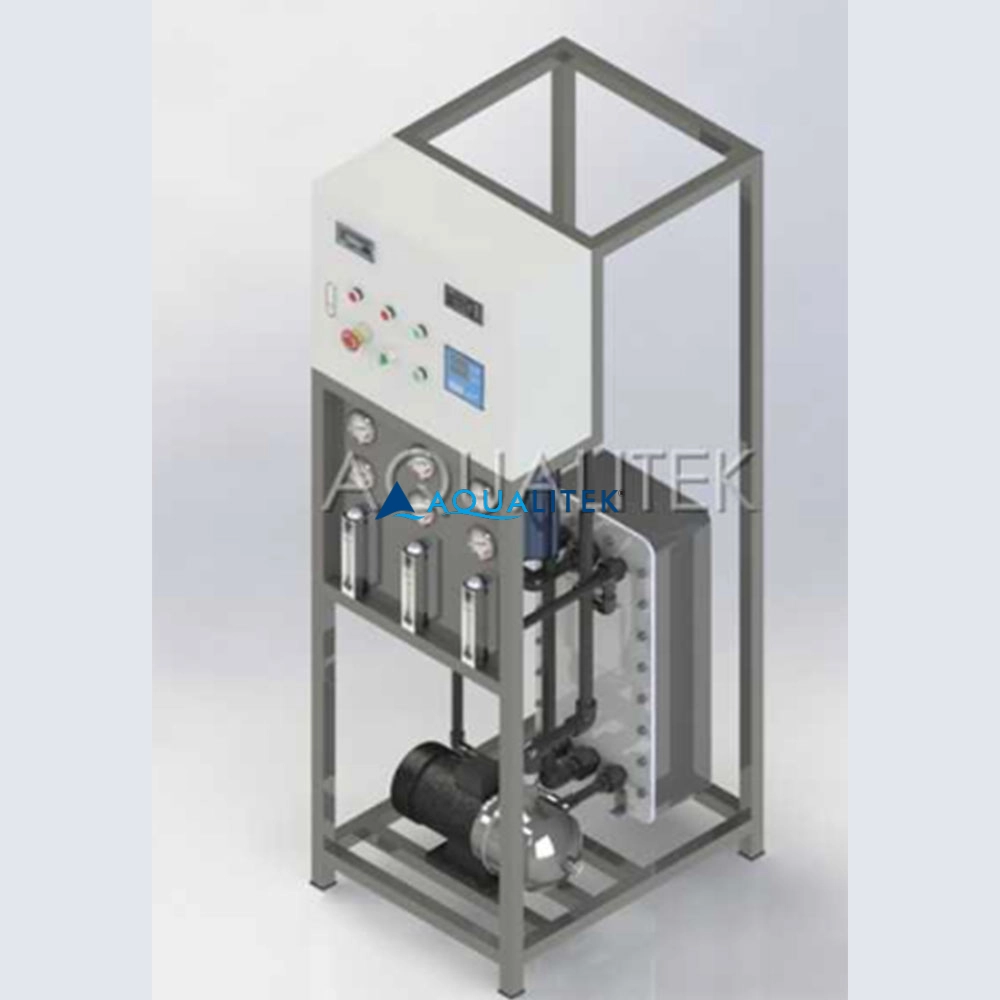
Validating Electrodeionization Systems for Pharmaceutical Water
FAQ-aqualitek
Are AQT’s water treatment products certified?
Yes! Our products comply with international quality and safety standards, including ISO, CE, and NSF certifications. We prioritize high-quality materials, advanced technology, and strict quality control to ensure superior performance and reliability.
Can I use AQT’s water treatment systems for seawater desalination?
Yes! We provide seawater desalination systems using advanced reverse osmosis (RO) technology, specifically designed to convert seawater into fresh, drinkable water. These systems are ideal for coastal communities, marine applications, and industrial desalination projects.
Can AQT provide custom water treatment solutions?
Yes! We specialize in OEM/ODM water treatment solutions and can design custom filtration systems tailored to your business, industry, or brand requirements. Our team can assist with system design, branding, private labeling, and technical support.
Solutions
Can AQT provide custom water treatment solutions?
Yes! We specialize in OEM/ODM water treatment solutions and can design custom filtration systems tailored to your business, industry, or brand requirements. Our team can assist with system design, branding, private labeling, and technical support.
Ion Exchange Water Treatment Systems
What is the difference between softening and deionization?
Softening removes only hardness ions (Ca²⁺, Mg²⁺), while deionization removes both cations and anions to produce high-purity water.
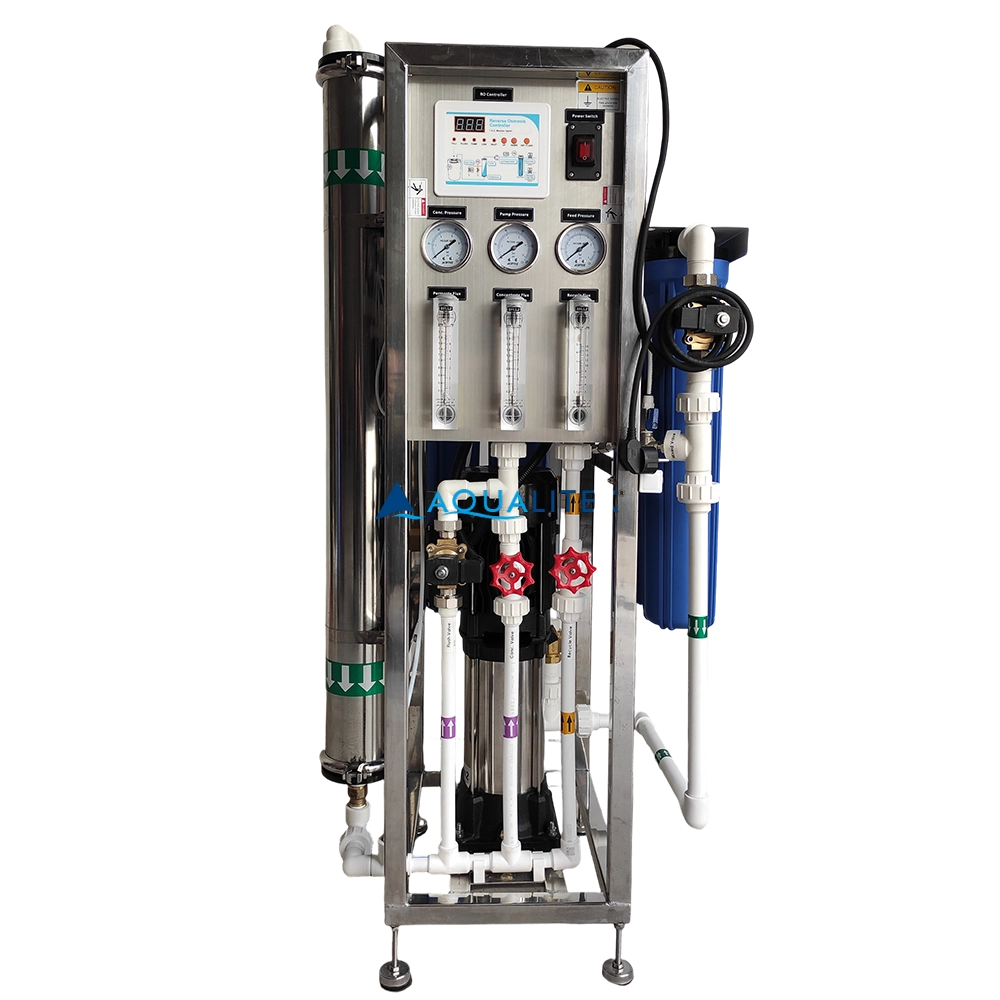
500 LPH Reverse Osmosis (RO) Water Purification Machine TWV - 412
Our 500 LPH Reverse Osmosis (RO) System is engineered to provide high-quality purified water for commercial applications. Designed with advanced RO technology, durable components, and a user-friendly interface, this system ensures consistent performance, low maintenance, and long-term reliability.
With its compact design and robust skid-mounted frame, it’s an excellent choice for businesses that demand efficiency and quality in water purification.
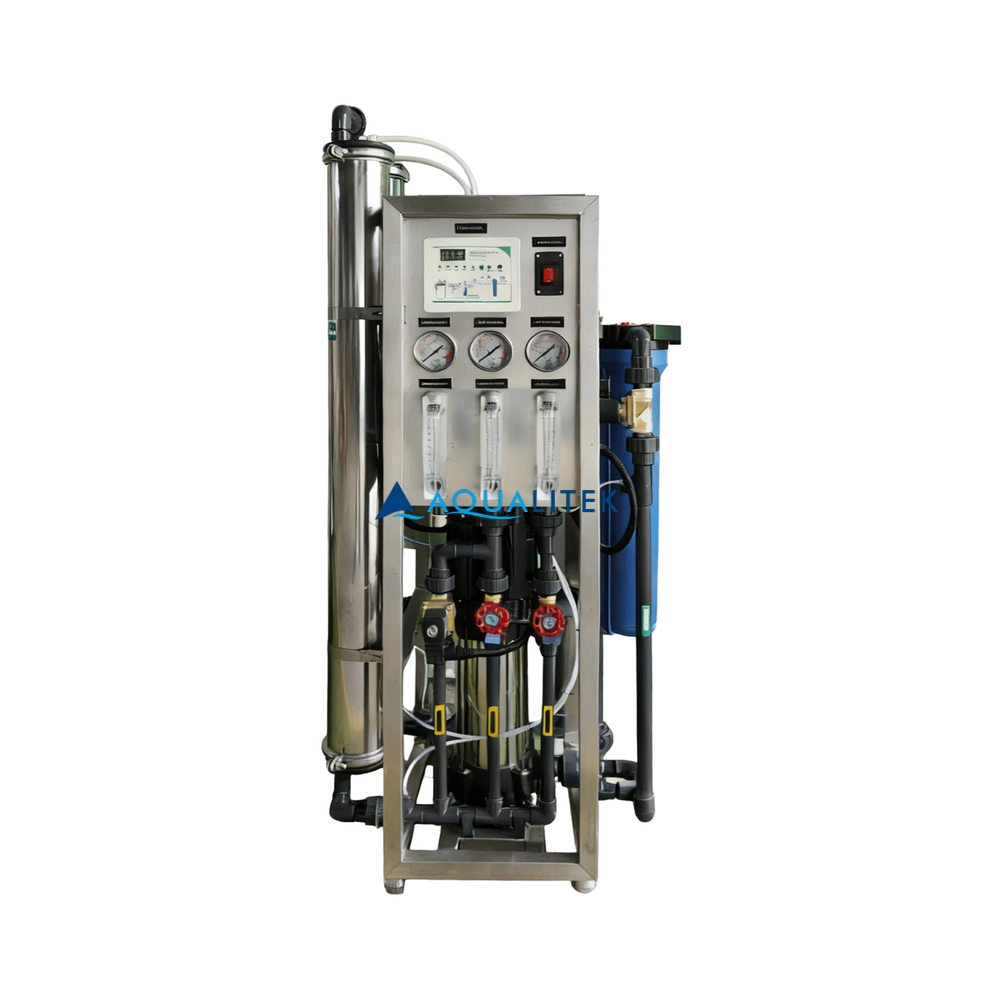
Tap Water Reverse Osmosis (TWRO) Systems TWV Series
TWV series Reverse Osmosis (RO) systems are pre-engineered and pre-assembled units with 2.5”/4” membrane housings(single element type)for tap water(lower TDS).They are designed for overall superior performance, high recovery rates and offer great savings with low maintenance and operation costs.
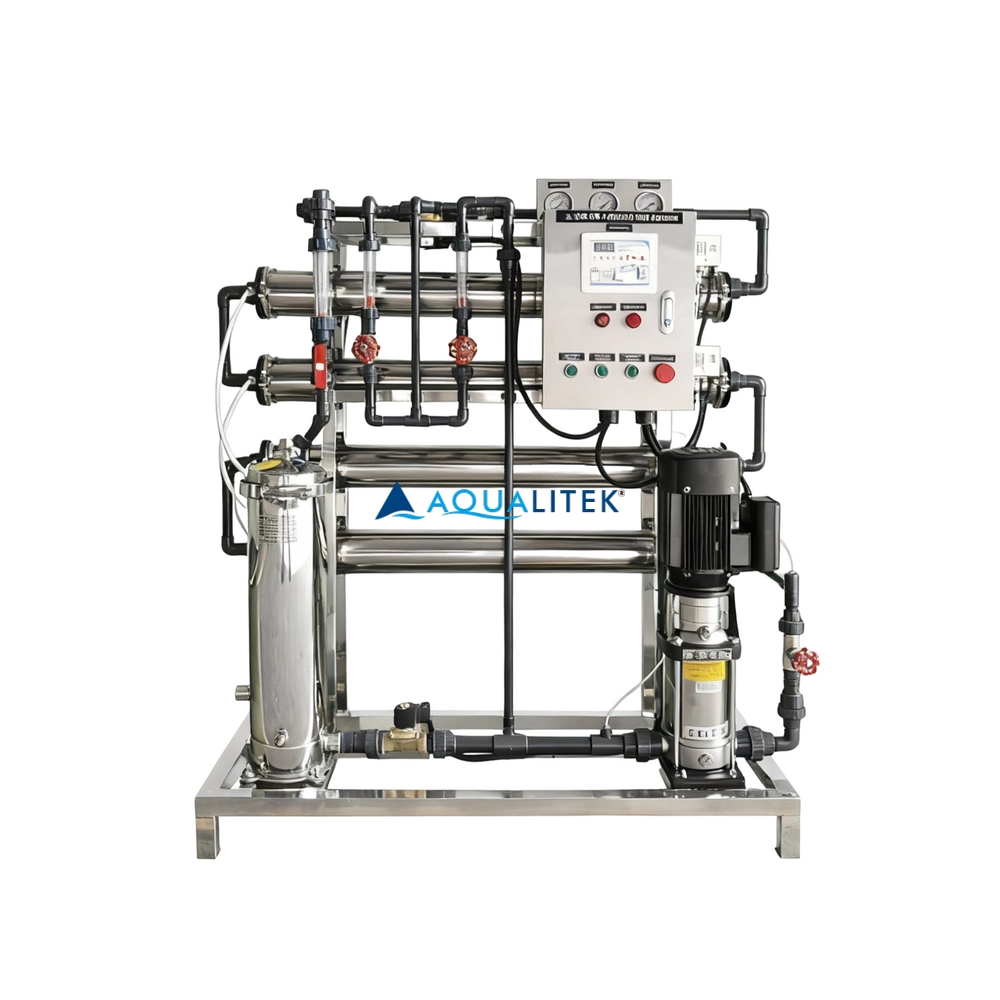
Tap Water Reverse Osmosis (TWRO) Systems TWF Series
TWF series Reverse Osmosis (RO) systems are pre-engineered and pre-assembled units with 4” membrane housings(multiple elements type) for tap water(lower TDS) .The medium large volumes can help meet your a variety of commercial and industrial applications. They are designed for overall superior performance, high recovery rates and offer great savings with low maintenance and operation costs.

Tap Water Reverse Osmosis (TWRO) Systems TWE Series
TWE series Reverse Osmosis (RO) systems are pre-engineered and pre-assembled units with 8” membrane housings for tap water (lower TDS). The large volumes can help meet your a variety of industrial applications. They are designed for overall superior performance, high recovery rates and offer great savings with low maintenance and operation costs.
Request More Information
Contact us today for product catalogs, customization options, and a free quotation designed for your business needs.
Rest assured that your privacy is important to us, and all information provided will be handled with the utmost confidentiality.
© 2026 AQUALITEK. All rights reserved.
AQUALITEK- Aimee Hoo
AQUALITEK - Aimee Hoo